Decibel chart explained: complete guide
Updated June 2026 - Practical dB reference for everyday noise
By Pankaj · Founder, SoundMeter · Reviewed against OSHA/NIOSH/WHO guidance
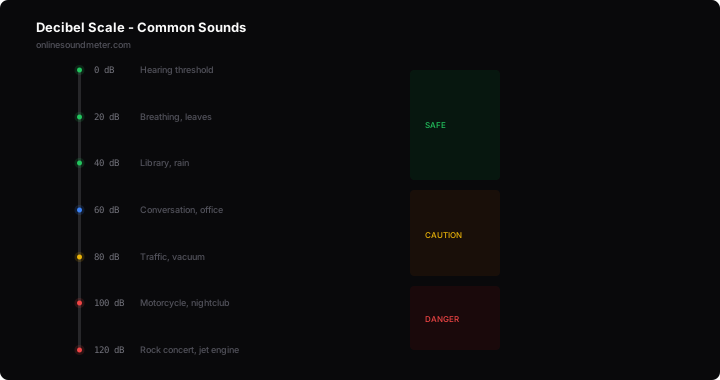
You hear "decibels" mentioned whenever noise comes up - workplace safety, apartment complaints, headphone warnings - but most people have no intuitive sense of what the numbers mean. Is 60 dB loud? Is 80 dB dangerous? How much louder is 90 dB compared to 70 dB?
This guide is a practical reference. It covers what decibels actually measure, maps common sounds to their dB levels, explains when noise becomes dangerous, and shows how a sound level meter turns those abstract numbers into something you can observe in real time.
What is a decibel?
A decibel (dB) is a unit that expresses the ratio between two values on a logarithmic scale. In acoustics, it measures sound pressure level - how much the air pressure fluctuates when sound waves pass through it.
The reference point is 0 dB SPL, the quietest sound a healthy young human can detect. A few important properties:
- Logarithmic, not linear. 80 dB isn't twice as loud as 40 dB. It's perceived as roughly 16 times louder.
- Every +10 dB sounds roughly twice as loud. 70 dB sounds about twice as loud as 60 dB to human ears.
- Every +3 dB doubles the sound energy. 83 dB carries twice the acoustic power of 80 dB - even though it barely sounds different.
- Human hearing range is roughly 0-130 dB. Above 120 dB causes pain. Above 140 dB risks immediate permanent damage.
The logarithmic nature is why decibel charts exist. Without one, the numbers are meaningless to most people.
Understanding a decibel chart
A decibel chart maps common sounds to their approximate dB level. Here's the thing most charts don't tell you: these values vary. A "normal conversation" can be 55 dB across a dinner table or 65 dB in a noisy bar. What matters more is the zones:
- 0-40 dB: Very quiet. You'd describe these environments as "silent" even though they're not.
- 40-70 dB: Normal. Comfortable indoor environments where you can talk without effort.
- 70-85 dB: Loud but tolerable. You raise your voice. No immediate danger, but fatigue over hours.
- 85-100 dB: Hazardous with duration. Time limits apply. Hearing protection recommended.
- 100+ dB: Immediately hazardous. Minutes of safe exposure. Earplugs essential.
Common sound levels in daily life
Measured at typical distances from the source:
| dB | Source | Context |
|---|---|---|
| 10-15 | Breathing, leaves | Near-silence |
| 25-30 | Whisper at 1m | Quiet bedroom |
| 35-40 | Library, rural night | What people call "quiet" |
| 45-50 | Home office, fridge hum | Good for focus work |
| 55-60 | Normal conversation | Typical indoor activity |
| 60-65 | AC unit, dishwasher | Noticeable but okay |
| 70-75 | Vacuum, busy restaurant | Speak up slightly |
| 80-85 | Food processor, traffic | Risk zone starts |
| 85-90 | Lawn mower, motorcycle | Protect for extended use |
| 95-100 | Subway, nightclub | 15-30 min safe |
| 100-110 | Power saw, concert | Minutes only |
| 120+ | Siren, jet engine | Pain / immediate risk |
Notice how many everyday activities sit in the 70-85 dB range. This is where most unrecognized hearing damage accumulates - loud enough to harm over hours, quiet enough that people don't think to protect themselves.
Safe vs dangerous noise levels
The question isn't just "how loud?" but "how loud for how long?" OSHA's noise standards define permissible exposure:
| dB | Max daily duration | Risk |
|---|---|---|
| ≤70 | Unlimited | Safe |
| 85 | 8 hours | Caution |
| 88 | 4 hours | Caution |
| 91 | 2 hours | Elevated |
| 94 | 1 hour | High |
| 100 | 15 min | High |
| 110+ | <2 min | Severe |
The WHO noise guidelines are more conservative for community noise, recommending sustained levels below 70 dB(A). For more on safe levels by environment, see our guide: what is a safe noise level in dB.
How a sound level meter works
A sound level meter captures sound through a microphone, measures the RMS amplitude of the signal, and converts it to decibels using logarithmic math: dB = 20 * log10(rms / reference).
Physical meters use precision condenser microphones with traceable calibration. Class 1 instruments are accurate to +/- 1 dB, Class 2 to +/- 1.4 dB. They cost $50 to $5,000+ depending on grade.
Software-based meters (phone apps, browser tools) use the same math but with consumer MEMS microphones. The mic is the limitation - uncalibrated, narrower frequency response, lower max SPL. The calculation itself is identical.
Online sound level meter vs real sound level meter
Whether a browser-based sound meter online can replace a real sound level meter depends on what you need:
| Factor | Online meter | Calibrated hardware |
|---|---|---|
| Accuracy | +/- 3-8 dB | +/- 1-1.4 dB |
| Calibration | None | Traceable cert |
| Freq. range | ~100 Hz - 8 kHz | 20 Hz - 20 kHz |
| Cost | Free | $50 - $5,000 |
| Compliance | No | Yes |
| Relative comparison | Reliable | Reliable |
For the question "is my room at 40 dB or 80 dB?" - both give you the same answer. A real sound level meter becomes necessary when exact numbers have consequences: OSHA audits, legal disputes, building certification.
How to measure sound levels accurately
Whether using an online tool or hardware, these improve your readings:
- Position the mic at ear height where you'd normally be sitting or standing. Not on a desk surface (vibrations) or against a wall (reflections add 2-6 dB).
- Measure for 2-3 minutes minimum. Under 30 seconds, a single event (door slam) skews the average.
- For browser tools: use Chrome, disable system audio enhancements, close other mic-using apps.
- Note the average, not the peaks. Peaks tell you the loudest moment. The average (Leq) tells you actual exposure over time.
Try measuring your environment
Open the meter, stay quiet for 60 seconds, compare your reading to the chart above.
Open sound level meterFrequently asked questions
What is the normal dB level for a home?
How many decibels is too loud?
Is a phone app as accurate as a real sound level meter?
What does 50 dB sound like?
How do I know if my environment is too noisy?
Does the decibel scale work linearly?
Can I measure decibels with just my browser?
What's the difference between dB and dBA?
Conclusion
A decibel chart is a translation tool. It converts an abstract logarithmic scale into something your brain can work with - "85 dB means lawn mower, and I shouldn't be in that for 8 hours." The most important takeaway: the 70-85 dB range is where damage happens unnoticed. It doesn't feel dangerous. Measuring once gives you awareness. That awareness is the difference between passive exposure and an informed choice.