What is a safe noise level in dB?
Updated June 2026 - Based on OSHA and WHO exposure guidelines
By Pankaj · Founder, SoundMeter · Reviewed against OSHA/NIOSH/WHO guidance
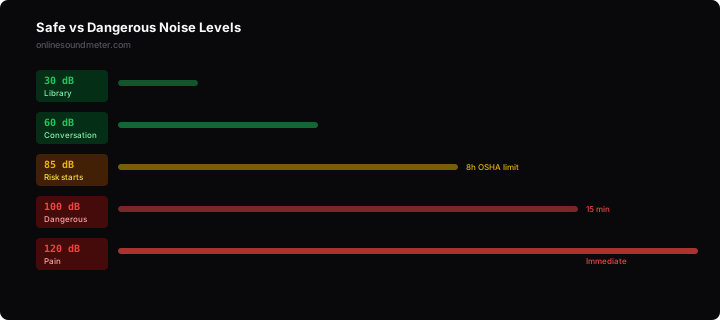
Most people have no idea how loud their daily environment actually is. We adapt to noise. The office hum, the commute, the gym playlist - it all feels normal until you measure it and realize you've been sitting in 75 dB for hours without thinking about it.
This guide covers what different decibel levels mean for your hearing, how long you can safely be exposed at each level, and what the thresholds are for bedrooms, offices, classrooms, and workplaces.
How decibels work
The decibel scale is logarithmic, not linear. 80 dB isn't "twice as loud" as 40 dB - it's thousands of times more sound pressure. In practical terms:
- Every 10 dB increase sounds roughly twice as loud to human ears
- Every 3 dB increase doubles the actual sound energy
- A "quiet" 50 dB room has 1,000 times less sound pressure than an 80 dB room
This is why the jump from 80 to 85 dB matters so much - it doesn't sound dramatically different, but the energy hitting your eardrums has increased significantly.
What's considered safe
Below 70 dB, you're fine indefinitely. That covers normal conversation, most indoor environments, and anything that doesn't require you to raise your voice to be heard.
Between 70 and 85 dB, risk is low for short exposure but starts accumulating over hours. This is the range where most people don't realize anything is wrong because it doesn't feel uncomfortable.
Above 85 dB, time limits apply. According to OSHA noise exposure standards, workers shouldn't exceed 85 dB(A) averaged over 8 hours without hearing protection. The WHO environmental noise guidelines are more conservative - they recommend keeping sustained exposure below 70 dB for community noise.
Decibel comparison table
| dB | Sounds like | Safe time | Risk |
|---|---|---|---|
| 20-30 | Whisper, quiet bedroom | Unlimited | None |
| 40-50 | Library, home office | Unlimited | None |
| 55-65 | Conversation, AC unit | Unlimited | None |
| 70-75 | Vacuum, busy restaurant | Unlimited* | Low |
| 85 | Heavy traffic, power tools | 8 hours | Moderate |
| 90 | Lawn mower, motorcycle | 2 hours | High |
| 100 | Nightclub, car horn close | 15 min | High |
| 110 | Rock concert, chainsaw | 2 min | Severe |
| 120+ | Siren, jet engine | Pain | Dangerous |
*WHO recommends limiting sustained 70+ dB community noise. OSHA doesn't regulate below 85.
Safe noise levels at home
Bedroom (sleeping)
The WHO recommends below 30 dB(A) for uninterrupted sleep. Common bedroom sources: HVAC (30-45 dB), partner snoring (40-60 dB), street traffic through closed windows (35-50 dB). If your bedroom regularly exceeds 40 dB at night, sleep quality is measurably affected even if you don't consciously wake up.
Working from home
For focused work: aim for 40-50 dB. Open-plan homes with kitchen appliances or nearby traffic often sit at 55-65 dB, which is why people wear headphones to concentrate. For video calls: ambient noise should be below 35-40 dB for your voice to come through cleanly.
Headphones and earbuds
This is where most people unknowingly damage hearing. Phone earbuds at full volume can output 100-110 dB directly into your ear canal. At 100 dB, you have about 15 minutes of safe exposure. Most people listen for hours. A practical rule: if you can't hear someone talking to you from arm's length with headphones on, the volume is likely above 85 dB.
Workplace noise limits
Offices
A private office sits at 35-45 dB. Open-plan ranges from 50-65 dB. Neither is a hearing hazard, but sustained noise above 55 dB measurably reduces cognitive performance - more errors, slower reading, higher end-of-day fatigue.
Industrial and construction
OSHA requires hearing protection above 85 dB TWA (time-weighted average). At 90 dB, permissible duration drops to 2 hours. Workers in manufacturing and construction routinely encounter 90-110 dB. Removing ear protection for even 5 minutes in 100 dB significantly increases daily average exposure.
Music and entertainment
Bartenders, DJs, and musicians face 95-110 dB sustained. OSHA allows 15 minutes at 100 dB. A typical bar shift is 6-8 hours. Custom musician earplugs (-15 to -25 dB, flat response) cost $15-200 and let you hear clearly at lower effective levels.
Classroom noise levels
Schools care about speech intelligibility more than hearing damage. Young children need a better signal-to-noise ratio than adults to understand speech. ANSI S12.60 recommends background noise below 35 dB(A) during instruction and reverberation under 0.6 seconds.
In practice, most classrooms hit 45-55 dB during instruction and 65-75 dB during group activities. A classroom noise meter on a projector helps students self-regulate during work time without constant teacher intervention.
When hearing damage actually happens
Noise-induced hearing loss is cumulative, painless, and permanent. Cochlear hair cells don't regenerate. Once they die, that frequency range is gone forever. For comprehensive prevention guidance, see NIOSH noise and hearing loss prevention.
Temporary Threshold Shift (TTS) is the warning sign. If sounds seem muffled after noise exposure, or you hear ringing that fades over hours, your cochlea was stressed. Repeated TTS episodes lead to permanent damage.
NIHL usually affects high frequencies first (4-6 kHz), which you don't use much in daily conversation. By the time you notice trouble understanding speech (1-4 kHz), significant damage has already occurred above. Common exposures people underestimate:
- Earbuds at 80%+ volume for hours (90-100 dB)
- Subway commuting (85-95 dB, 30-60 min twice daily)
- Gym with amplified music (90-100 dB for 60-90 min)
- Mowing lawn without protection (90 dB for 45-60 min)
- Concerts without earplugs (100-115 dB for 2-3 hours)
How to measure your environment
You don't need expensive equipment. A browser-based sound meter online uses your device microphone to give you a rough reading - accurate enough to tell the difference between a safe 45 dB room and a concerning 80 dB environment.
Quick check: open the meter, stay quiet for 60 seconds, read the average. That's your noise floor. Then measure during normal activity to see actual exposure. If you're regularly above 80 dB, even cheap foam earplugs (reducing 15-25 dB) turn an unsafe 95 dB environment into a manageable 70-75 dB one.
Check your environment now
Open the meter, stay quiet for 60 seconds, see what your space actually measures.
Open sound meterFAQ
What dB level is considered safe for 8 hours?
Can 60 dB damage hearing?
Is 85 dB really that loud?
What's a safe noise level for sleeping?
How loud is too loud for a classroom?
Do noise-canceling headphones protect hearing?
How do I measure noise levels without buying equipment?
Bottom line
Below 70 dB - no concern. Between 70-85 dB - be aware of duration. Above 85 dB - limit exposure or wear protection. Most people have no idea what number their environment hits until they measure it. The gap between "this feels fine" and "this is causing damage" is where most hearing loss happens.