Noise level chart for home, office and workplace
June 2026
By Pankaj · Founder, SoundMeter · Reviewed against OSHA/NIOSH/WHO guidance
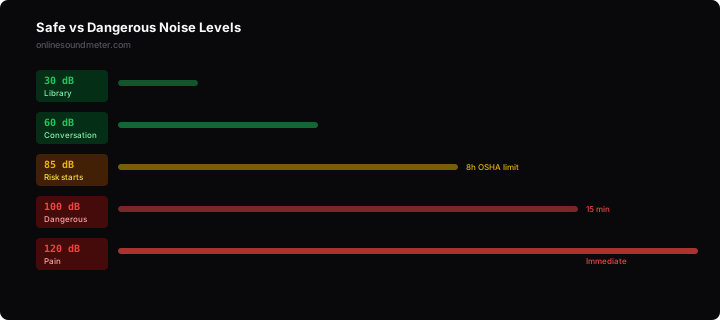
Noise is one of those things everyone has opinions about but few measure. "It's too loud in here" means different things to different people. A decibel chart gives you actual numbers.
Home noise levels
| Space | dB | Notes |
|---|---|---|
| Bedroom (night) | 25-35 | HVAC off. Fans add 35-45. WHO night noise guidelines for Europe recommend below 30 dB |
| Living room | 35-45 | No TV, ambient hum |
| Kitchen (cooking) | 55-70 | Hood, dishes, sizzling |
| Home office | 35-50 | Computer, AC |
| Vacuum cleaner | 70-80 | Loudest common device |
Office noise levels
| Type | dB | Impact |
|---|---|---|
| Private office | 35-45 | Good for focus |
| Shared office | 45-55 | Headphones help |
| Open plan | 55-65 | Concentration drops |
| Call center | 65-75 | Voice strain |
Cognitive performance drops above 55 dB - more errors, slower reading, higher fatigue.
The open-plan office problem
Let's be real about something: open-plan offices are a noise disaster. They typically register 55-65 dB during active hours - well above the 45 dB threshold where focused cognitive work starts to suffer. The irony is that companies adopted open plans to boost "collaboration," but the constant noise actually reduces the quality of both solo work and conversations (because you're competing with everyone else's conversations).
If you work in an open plan and want to quantify the problem, take readings at your desk throughout a typical day. You'll likely find peaks of 70-75 dB when nearby colleagues are on calls, and valleys of 50-55 dB during quiet periods. That variability is actually worse than a constant 60 dB - your brain keeps getting pulled out of focus by the changes.
Solutions that actually work: noise-cancelling headphones drop your experienced level by 20-25 dB. Sound-masking systems (white/pink noise through ceiling speakers) raise the background floor so conversations beyond 4-5 meters become unintelligible. And honestly? Sometimes the answer is just a door. Private offices exist for a reason.
Workplace and industrial
| Setting | dB | OSHA note |
|---|---|---|
| Retail store | 60-70 | No protection needed |
| Restaurant kitchen | 75-85 | Monitor time |
| Manufacturing | 80-95 | Protection above 85 |
| Construction | 85-110 | Mandatory protection |
Schools
ANSI S12.60: background below 35 dB(A) during instruction. A classroom noise meter helps track this. For safe levels detail: safe noise level guide.
Why does this matter so much for schools? Children's brains are still developing auditory processing. A kid trying to learn in a 55 dB classroom misses roughly 25-30% of consonant sounds compared to a child in a 35 dB room. That might not seem like much, but over a full school year, it compounds into real learning gaps - especially for non-native English speakers or children with mild hearing difficulties that haven't been diagnosed yet.
Outdoor and transportation noise
Indoor noise gets all the attention, but outdoor environments are often louder than people realize. Here's what you'll encounter once you step outside.
| Source | Distance | dB |
|---|---|---|
| Passenger car (steady) | 15 meters | 65-70 |
| City bus accelerating | 10 meters | 75-82 |
| Diesel truck | 15 meters | 80-90 |
| Train (commuter rail) | 30 meters | 75-85 |
| Motorcycle | 10 meters | 85-95 |
| Airplane overhead (landing) | 300 meters | 80-90 |
| Emergency siren | 30 meters | 90-100 |
Notice how distance matters enormously. That same bus at 2 meters hits 90+ dB. If you live on a busy road, closed windows typically knock off 20-25 dB, which is why an 80 dB street might mean 55-60 dB inside - still noticeable, but manageable.
Interpreting readings for landlord complaints
Here's the thing about noise complaints: your subjective experience matters, but numbers get results. Landlords and noise ordinance officers respond differently when you can say "it's consistently 55 dB in my bedroom at midnight" versus "it's really loud."
Most residential noise ordinances set nighttime limits between 35-45 dB at the property boundary. Some cities measure inside the affected apartment instead. Before filing a formal complaint, take readings over several nights at the same time. Screenshot or log them. Pattern data is far more convincing than a single measurement.
A few practical benchmarks for landlord situations:
- Above 45 dB in a bedroom at night - reasonable grounds for complaint
- Above 55 dB during daytime from neighbor activity - worth documenting
- Impact noise (footsteps, bass) above 50 dB - often violates lease terms
- Consistent 60+ dB from building systems (HVAC, elevator) - maintenance issue
Even a browser-based meter won't hold up in court, but it gives you enough evidence to start the conversation and get your landlord to take action.
Seasonal noise variation
Something most people don't consider: noise levels in your home change dramatically with the seasons. It's not just about windows being open in summer - though that's a big factor, typically adding 15-25 dB of outdoor noise bleed.
In winter, closed windows and thicker air create a quieter indoor environment. Snow on the ground absorbs outdoor sound. Your home might sit at 30-35 dB on a snowy night versus 45-50 dB on a summer evening with windows cracked.
Summer brings lawnmowers (85-90 dB from the neighbor's yard), air conditioning units running (50-65 dB depending on the system), kids playing outside, and longer hours of activity. Fall brings leaf blowers - arguably the most universally hated seasonal noise at 90-100 dB.
If you're trying to assess whether your space meets WHO guidelines or workplace standards, measure during your loudest season. That's your real baseline. A room that scores 38 dB in February might hit 52 dB in July with the AC running and traffic noise leaking through open windows.
Understanding noise ratings and standards
You'll see different standards referenced depending on context. Here's a quick decode:
dB(A): The most common weighting. Filters out very low and very high frequencies to match how human ears perceive sound. Almost every residential and workplace standard uses A-weighting. When someone says "85 dB," they almost always mean dB(A).
NC (Noise Criteria) curves: Used by architects and HVAC engineers to rate background noise in buildings. NC-25 is a very quiet office. NC-35 is acceptable for open-plan work. NC-40 is a corridor or lobby. If your office lease specifies "NC-35," that roughly translates to 40-45 dB(A) of background sound.
STC (Sound Transmission Class): Rates how well walls and floors block sound between rooms. A standard interior wall is STC 33-35. A well-built apartment separation should be STC 50+. If you can clearly hear your neighbor's conversations, your shared wall is probably below STC 40.
For most practical purposes - measuring your home, checking your office, filing a noise complaint - you only need dB(A). The other ratings matter when you're building or renovating rather than just measuring.
Quick rules of thumb
Don't want to memorize tables? These simple rules cover 90% of practical situations:
- Below 40 dB: Suitable for sleeping, recording, and focused work. You probably won't complain about noise here.
- 40-55 dB: Normal indoor background. Fine for most activities. Focus may suffer above 50 for detail-oriented work.
- 55-70 dB: Active sound. Conversation level. Expect to notice it and potentially be annoyed during quiet activities.
- 70-85 dB: Loud. You'll raise your voice to talk. Safe for short periods, but extended exposure starts warranting attention.
- Above 85 dB: Hearing protection territory. The longer you're here without protection, the more damage accumulates.
If you can't have a normal conversation without raising your voice, you're above 70 dB. If you have to shout, you're above 85. These body-based checks work anywhere, no equipment needed.
How to use this chart
To find where your space falls, open the sound meter online and run a 2-3 minute measurement during normal activity. Compare your average to the ranges above.