Online sound meter vs real sound level meter
June 2026
By Pankaj · Founder, SoundMeter · Reviewed against OSHA/NIOSH/WHO guidance
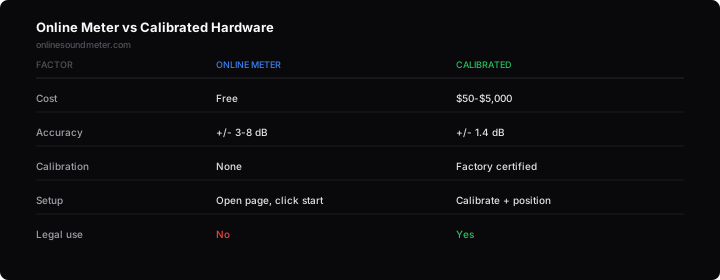
"Should I buy a meter or just use a website?" depends entirely on what you plan to do with the reading.
The fundamental difference
A real sound level meter has a factory-calibrated microphone with known sensitivity, traceable to a national measurement standard. When it shows 85 dB, that number has documented uncertainty (+/- 1.4 dB for Class 2).
An sound meter online uses whatever microphone your device has, no calibration reference. The math is identical - same RMS, same log conversion. The hardware chain differs.
In plain terms: both tools do the same calculation. They both capture audio, compute the root-mean-square pressure, and convert it to decibels using the standard logarithmic formula. The difference isn't in the math - it's in whether the microphone feeding that math has a known, documented sensitivity. A professional meter's microphone has been measured against a reference standard and comes with paperwork proving it. Your laptop mic? It works, but nobody wrote down its exact characteristics.
Comparison
| Factor | Online | Hardware (Class 2) |
|---|---|---|
| Accuracy | +/- 3-8 dB | +/- 1.4 dB |
| Relative accuracy | +/- 1-2 dB | +/- 0.5 dB |
| Freq range | ~100-8k Hz | 20-20k Hz |
| Cost | Free | $100-800 |
| Setup time | 5 seconds | 5-15 min |
| Legal/compliance | No | Yes |
When online is the right choice
- Quick answer without buying or setting up anything
- Relative comparison (room A vs room B)
- Large decision threshold (35 dB vs 70 dB, not 83 vs 85)
- Classroom display on a projector
- Multiple people need access
When you need hardware
- OSHA compliance reports
- Legal noise disputes
- Measuring below 30 dB or above 110 dB
- When 3 dB difference changes your action
For accuracy details: accuracy guide. For dB reference: decibel chart.
Cost breakdown: what you're actually paying for
| Item | Online meter | Budget hardware | Professional (Class 1) |
|---|---|---|---|
| Purchase price | $0 | $50-200 | $800-5,000 |
| Annual calibration | N/A | $50-100 | $150-300 |
| Battery/maintenance | $0 | $10-20/yr | $30-50/yr |
| 5-year total cost | $0 | $300-700 | $1,550-6,750 |
| Software updates | Automatic | Sometimes paid | Often paid |
That annual calibration requirement catches people off guard. A Class 2 meter needs yearly recertification to remain legally valid - skip it, and your $200 device produces legally worthless data, same as the free browser tool. It's not just about buying the meter; it's committing to maintaining it.
Real user scenarios: who needs what
The teacher monitoring classroom noise: Needs a visual display the whole class can see, doesn't need decimal precision. A browser meter projected on the whiteboard is perfect - and it's free for every classroom in the school. No budget requests, no lost equipment, no batteries dying mid-lesson.
The podcaster checking room acoustics: Needs to know "is my room quiet enough for recording?" (under 30 dB) and "is there a hum I should address?" Relative readings matter more than absolute accuracy. An online meter answers both questions instantly.
The HVAC engineer commissioning a building: Must demonstrate compliance with NC (Noise Criteria) ratings specified in the contract. Needs documented calibration, frequency weighting options (A, C, Z), and octave-band analysis. This person needs a $500+ meter with current calibration cert - no question.
The renter fighting a noise complaint: Needs to show a landlord that upstairs neighbors exceed reasonable levels at night. A phone or browser reading with timestamps is surprisingly effective for this conversation. For an actual legal case? You'd need calibrated equipment.
The factory safety officer: Must conduct annual noise surveys per OSHA regulations, document TWA (time-weighted average) exposures, and maintain records for 30 years. There's zero question here - Class 2 minimum, often Class 1 for litigation protection.
Recommendation matrix
| Your situation | Best option |
|---|---|
| "Is my room too loud?" | Online meter (free, instant) |
| Comparing two spaces | Online meter or phone app |
| Classroom display | Online meter (projector-friendly) |
| Informal noise complaint | Phone app with screenshots |
| Home studio setup | Budget Class 2 ($100-200) |
| OSHA workplace survey | Class 2 with current calibration |
| Legal noise dispute | Class 1 with certified operator |
The gap in context
Online meter shows 72 dB where professional reads 75. Does that difference change your decision? "Is my room quiet enough for recording?" - both say the same thing. "Is my workplace OSHA-compliant at exactly 85?" - the difference matters there.
Most questions are the first kind. See also: safe noise levels guide.
Maintenance and calibration: the hidden commitment
Here's something the spec sheets don't emphasize: owning a professional meter is an ongoing commitment, not a one-time purchase. A Class 2 meter must be calibrated annually to maintain its accuracy certification. Skip calibration, and your $300 meter is legally no better than a browser tool - it produces numbers, but nobody is required to trust them.
Calibration involves sending the device to a certified lab (or bringing an acoustic calibrator to it before each measurement session). Lab calibration runs $75-150 per year. An acoustic calibrator (a device that produces a known 94 dB or 114 dB tone) costs $200-400 to buy outright. Either way, you're investing time and money annually to keep the device honest.
Online meters don't have this problem. They don't drift because there's nothing to drift - the algorithm is fixed, and whatever accuracy limitations exist from the microphone hardware are consistent day to day. You won't get traceable calibration, but you also won't get degrading accuracy that gives you false confidence.
For someone who measures noise once or twice a year, the total cost of ownership for a professional meter (purchase + calibration + batteries + time) can easily exceed $500 over three years. That's a lot to spend for occasional use when a free tool answers the same practical question 90% of the time.
When accuracy doesn't matter (and when it really does)
Let's be honest about something: for most people asking "how loud is it?" the difference between 72 dB and 75 dB doesn't change a single decision they'll make. The action they'll take is identical either way.
Accuracy genuinely matters when you're within 3 dB of a regulatory threshold. If your workplace measures 83 dB on an online meter, you don't know whether you're at 80 (safe, no action needed) or 86 (OSHA violation, mandatory hearing program). That 3 dB of uncertainty crosses a legal line. In that specific situation, you need calibrated hardware.
But consider: how often is the average person within 3 dB of a regulatory threshold? Almost never. You're asking "is my baby's room quiet?" (it's either 30 dB or 55 dB - the tool doesn't need precision to tell you). Or "is this restaurant too loud for conversation?" (it's clearly 70+ dB or clearly under 60). The gaps are large, and any measurement tool - browser, phone, or professional - gives you the same answer.
FAQ
Can an online meter replace a professional one?
How much does a real sound level meter cost?
What does Class 1 and Class 2 mean?
Do I need a professional meter for noise complaints?
Is a $50 meter better than an online meter?
Why do online meters exist?
They're not competing products. The free tool answers "approximately how loud?" The hardware answers "exactly how loud, with documentation." Most questions are the first kind.
Think of it like a kitchen scale versus a lab balance. Both measure weight. One costs $15 and tells you your chicken breast is roughly 200 grams. The other costs $2,000 and measures to 0.001 grams with a calibration certificate. For cooking dinner, the kitchen scale is perfect. For pharmaceutical manufacturing, you need the lab balance. Sound measurement works the same way - match the tool to the question you're actually asking.